Brewster’s Trillions
TL;DR
The AI infrastructure bubble has reached a point where companies just can’t actually spent all the money they might (notionally) have allocated. There might be money on a balance sheet somewhere, but good luck exchanging it for actual GPUs, or HVAC, or HVAC installers, or… When the sums of money get large enough it turns out that it’s difficult to actually spend it. That was the setup for George Barr McCutcheon’s 1902 novel ‘Brewster’s Millions‘ (and the multitude of film adaptations). Of course the sums of money now are MUCH, MUCH, BIGGER, which is why I’ve taken to calling this Brewster’s Trillions (or the Brewster’s Trillions problem).
Brewster’s Millions
The plot device of the book is that Montgomery Brewster must spend $1M within a year in order to inherit a much larger sum (timing and values vary in the films). This turns out to be more difficult that it initially seems, as he has to finish with no assets, and there are limitations on gifts, donations etc.
Various comedy sub plots get built around the notion that when you have lots of money, it’s hard to actually spent it all, especially if you’re working to a deadline.
AI spending
This chart from Fin Moorhouse got lots of attention a few months back:
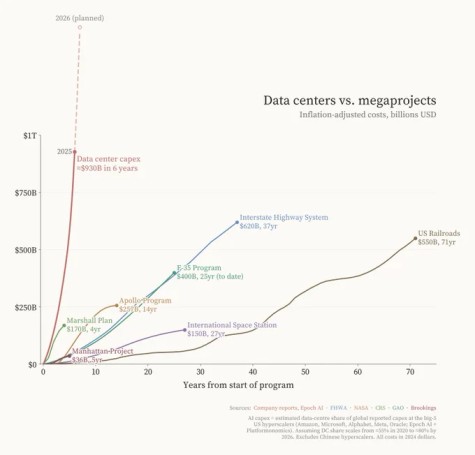
But news is starting to come in that stuff planned for 2026 isn’t actually happening[1]. It turns out that when you buy ALL the stuff, whether that’s land for data centres, or GPUs to run in them, or HVACs to keep them cool, or energy to power all that, or contractors to do the installation work and maintenance; you can’t just show up with more money and buy more of the same. That’s because the earlier buying has exhausted supply, and whilst economics 1.01 will kick in and inflate prices (viz RAM[2]) a point is quickly reached where certain things can’t be bought at any price. For much of the AI supply chain we’ve already passed that point. Companies that locked in deals early might continue to get what’s being made, and the makers might do their best to expand capacity. But all that takes time, and so the rate of spending has to bend.
Stein’s Law is now in effect:
If something cannot go on forever, it will stop.
Notes
[1] 35-50% of planned AI data centres are behind schedule
[2] Tom’s Hardware now has a headline category for RAM Shortage
Filed under: Uncategorized | 2 Comments
Subscribe
Recent Comments
Electrónica de Consu… on September 2026 Chris Swan on July 2026 Tim Swan on July 2026 Chris Swan on Brewster’s Trillions Ian Osborne on Brewster’s Trillions  Pinboard.in bookmarks
- An error has occurred; the feed is probably down. Try again later.


Well, that goes some way to answering my question of last week, i.e. is the current splurge on datacenters being driven by need or is it speculative. It would seem that people are building capacity ahead of presumed need. Could they not repurpose existing infrastructure, or is that already being done? And, if there are not enough GPUs, AC equipment, or land or water – does this cause a slowdown, or a more strategic review and investment. I would guess the latter …
The picture is a little more complex than that…
The ‘need’ is clearly there, as the frontier labs have more demand for their services than they have capacity to deliver. Hence restrictions on latest models.
But, as a wise colleague once said “there’s infinite demand for free stuff”, and the labs are selling services at pennies on the dollar to the cost of delivery. It’s the classic silly valley play to grasp customers and build a monopoly, then fix pricing later. That latter part was previously hitched onto Moore’s law, and the expectation that costs would descend over time; but I’m not sure that plays so well in 2026 given that the easy wins (e.g. tensor cores) have already been bagged.
Also there’s almost no customer stickiness. Models and harnesses are largely interchangeable, and if you don’t like today’s there will be another one along shortly.
We’ve already seen economics 1.01 start to re-assert itself, with the hikes in token pricing and curtailing of ‘all you can eat’ subscriptions that came in last month. The lingering question will be price elasticity of demand.