Despite the lack of comments (yet) the post on persona has resulted in some good behind the scenes debate.
Something that came out of this is that I agreed to post an illustration of how a legal entity fits into the persona illustration in order to effect the LLP concept:
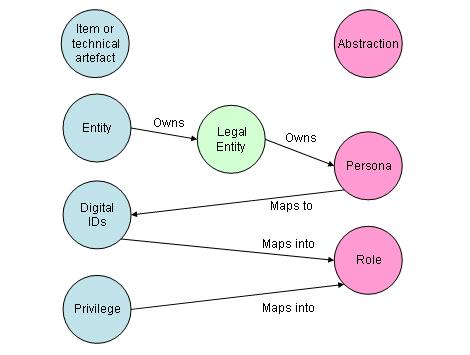
Sadly this still leaves us with a missing mechanism for creating the appropriate legal entities. Companies (e.g. Ltd in the UK or LLC in the US) could be used, but seem a bit cumbersome and therefore unfit for purpose. I’m not a lawyer, but I do find myself wondering if trusts could be used in this context (e.g. legal trust meets IT trust)?
Filed under: security | 5 Comments
Tags: identity, idm, llp, persona, security, trust
RSS Feed
I’m always annoyed when I can’t find an obvious link to an RSS (or ATOM) feed for a blog that I like, so I’m doubly annoyed that I can’t find an obvious way to have one for this blog. Maybe I’ve just made a poor choice of theme that puts style ahead of substance?
Anyway, the default feed can be found here (which I think is RSS 2.0) , other RSS flavours and ATOM are also available.
Filed under: this blog | 2 Comments
Tags: rss
Persona
OK, it’s time for my first serious post, and it’s not about a brand of fertility monitor.
Persona is a term that’s increasingly being used in conversations around digital identity, but it’s not one that I typically find to be well defined. The Wikipedia entry doesn’t help much, as it is about the more general definition of persona as ‘a social role’. When I checked the Identity Gang glossary (or Identipedia) the last time I was looking for help that didn’t help either, though I now see that there are a number of definitions there (I can’t decide whether this is better or worse than none at all). The discussion about Limited Liability Persona is getting some more traction in the aftermath of the Scoble/FaceBook debacle, but that concentrates on a proposed legal framework and the underlying definition of persona is somewhat implicit.
The purpose of this post is to put forward my own definition, and hopefully by eliciting some comments it will be possible to find some sort of consensus definition.
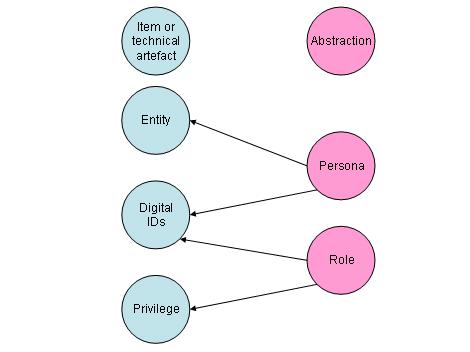
It is my contention that persona is an abstraction between an entity (usually a biological entity, or person) and a bundle of one or more digital identifiers, so that the entity can present themselves differently according to context. This is similar to using a role as an abstraction between a digital identifier and a bundle of privileges (though I’m increasingly leaning towards attribute based access control [ABAC] in favour of role based access control [RBAC] as role management is a deep and sticky tar pit).
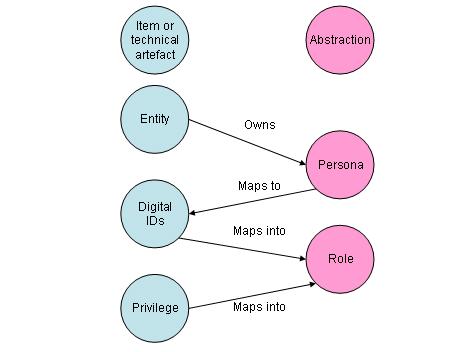
At this stage it’s usually helpful to offer some examples:
-
‘Blogger’ – my persona of ‘blogger’ associates with my digital identity (OpenID) ‘thestateofme.wordpress.com’, which in turn places me in the role of ‘author’, which gives me the privilege to ‘post’, ‘approve comments’ etc.
-
‘Web surfer’ – my persona of ‘web surfer’ associates with a bundle of digital identities (OpenID, search engine company, web mail provider etc.), which in turn place me into roles like ’emailer’, ‘photo uploader’ that then let me have privileges like ‘send email’, ‘create new album’ etc.
-
‘Employee’ – my persona of ’employee’ gets me a bundle of digital identities that are mostly issues by my employer, some on internal systems, others on Internet connected system with different namespaces…
Hopefully you’re getting the drift by now, and this helps?
Filed under: security | 6 Comments
Tags: digital identity, idm, llp, persona, security, trust
The run up to Christmas found me once again looking for the digital camera that I want (and many hours at dpreview.com). My requirements are simple (and I’m not deceived by the ‘megapixel madness‘) – I’d like a large imaging area (e.g. 35x24mm), a reasonable size and weight (<600g is probably in the right ball park) and not too expensive (<$1000 seems about right). Basically I want a high end sensor in a consumer body. Nobody makes such a camera, and from what I can tell nobody plans to make one in the foreseeable future. So… I gave up on the specs, and ended up buying a cheap end of line compact that was defined by having a very good image sensor – handy for those low light shots without flash.
My experience since then has convinced me that buying a DSLR would probably have been an error anyway. You can only take pictures when you have the camera with you, and that’s a whole lot more likely when it fits into a pocket rather than requiring its own luggage. I’m willing to concede that a very small lens on a reasonably small DSLR body might just about do the trick, though I somehow feel that being the guy walking around with a camera slung around their neck defines somebody as ‘photographer’. Anyway, I wouldn’t have got this shot with a DSLR, as I had to poke the lens through the bars of the cage:

This particular camera is now my 3rd digital compact, and it seems that the 3rd time is the charm. My first was hopelessly lacking in resolution (at a mere 1.3MP) and the second just wasn’t responsive enough. The best thing about the new model is that it does stuff immediately when you press whatever button. Things also seem to have improved in UI land over the last few years with stuff like transitioning from review mode back to taking pictures.
The improvement in responsiveness seems to have been what was needed to get Rachel to leave behind her 35mm compact and go digital on our recent Christmas holiday. This allowed us to share pictures with family and friends back at home in a way that leaves me questioning the need for hard copy prints. In the end we got some hard copies anyway, with the plan being to create a collage, and every print was good because we had the opportunity to crop and edit and eliminate red eyes before pigment ever met paper. I’m impressed with the quality of some of the highly cropped pictures too. For ages I’d clung on to using a 35mm SLR and a 12MP film scanner for stuff, but now I realise that I’ve still not done anything about the SCSI driver issue I met with the film scanner versus my new PC – and that was almost 2 years ago.
So… it seems digital photography is ‘winning’, and like most things digital it’s winning on convenience more so than quality.
Filed under: photography | 4 Comments
Tags: camera, DSLR, photography
Quotation mashup
Hugh came out with a good one today – “any sufficiently advanced stupidity is indistinguishable from malice“. This is a close cousin of Grey’s law, which gets a mention on the Wikipedia page for Hanlon’s razor. It seems like a good mash up of a couple of my old favorites – Napoleon’s “never ascribe to malice, that which can be explained by incompetence”, and Arthur C Clarke’s “any sufficiently advanced technology is indistinguishable from magic”.
Filed under: wibble | 2 Comments
Hello world!
Welcome.
It’s taken me too long to get here, but better late than never I hope.
I’ve been lurking in the blogosphere for a long time now, but there have always been a couple of things holding me back from being more active. Firstly there was the issue of corporate policy – my employer is rather sensitive about electronic communications, but has of late got around to formulating a policy about blogging – so at least I know what the rules are now, and whilst that means I probably can’t say everything I would wish to it’s better than nothing. Secondly there was the question of needing to have something interesting to say. JP convined me that the real value of a blog was in the comments rather than the monologue. So perhaps I don’t need to say anything interesting – you do!
If by now you are wondering where ‘thestateofme’ comes from then I’ll use my first post to give a short explanation… In the early days of reading other people’s blogs I was constantly frustrated by the lack of synchronisation between my RSS aggregator at home, at work, on my laptop etc. That particular journey eventually led me to RSS Bandit, which has some great remote sync features using WebDAV etc. (though my feature request for S3 fell on deaf ears). Along the way though it looked like I might have to create a state management service (and schema) to handle synchronisation, and so I went and registered thestateofme.com (which I now use in part to host the WebDAV end point that I do use for sync, so all was not in vain). Anyway… it seemed like a reasonably good title for my blog too, so here we are.
Filed under: wibble | 2 Comments
Tags: welcome blogging


 Chris Swan's Weblog